

Structuring Product Data for AI Agents and Agentic Commerce in 2026
In the fast-evolving world of ecommerce, optimizing product data for AI agents in ecommerce is no longer optional—it's the foundation of agentic commerce success. By 2030, agentic commerce could drive up to $1 trillion in US B2C retail revenue alone, with global opportunities reaching $3-5 trillion in goods sales.[1] AI agents acting on behalf of shoppers demand structured, machine-readable product data to discover, compare, negotiate, and transact seamlessly. Poorly structured data leads to invisibility in AI-driven shopping, while well-prepared catalogs unlock recommendations in platforms like ChatGPT, Gemini, and emerging agentic interfaces. This guide dives deep into structuring your product data to thrive in 2026's agentic landscape.
Why Structured Product Data is Critical for AI Agents in Ecommerce
AI agents don't browse like humans—they parse data at machine speed. As McKinsey's Naveen Sastry notes, "Agentic commerce is flipping the script... How do you make your offering ‘agent discoverable’?"[1] In agentic commerce, agents handle everything from query interpretation to purchase execution, relying on semantic metadata, standardized attributes, and interoperable APIs.
Current stats underscore the urgency: AI platform-driven ecommerce sales are projected to hit $144 billion globally by 2029, representing 8.8% of total retail ecommerce.[2] Meanwhile, the broader AI agents market grows from $7.84 billion in 2025 to $52.62 billion by 2030 at a 46.3% CAGR, with retail as a prime segment.[3] Yet, challenges persist: Reddit discussions highlight that messy catalogs doom AI performance—"poor data = failure."[4]
For ecommerce sellers, this means prioritizing product data AI agents ecommerce readiness. Agents like OpenAI's Operator or Google's Business Agent scan for rich attributes (e.g., material, fit, sustainability), behavioral signals (e.g., loyalty eligibility), and real-time availability. Becca Coggins from McKinsey emphasizes rethinking engagement "not for the people... but for the agents now acting on their behalf."[1] Get this right, and your products surface in 44% of AI-powered searches preferred over traditional engines.[1]
Emerging Standards: UCP, ACP, and Beyond for Agentic Data Interoperability
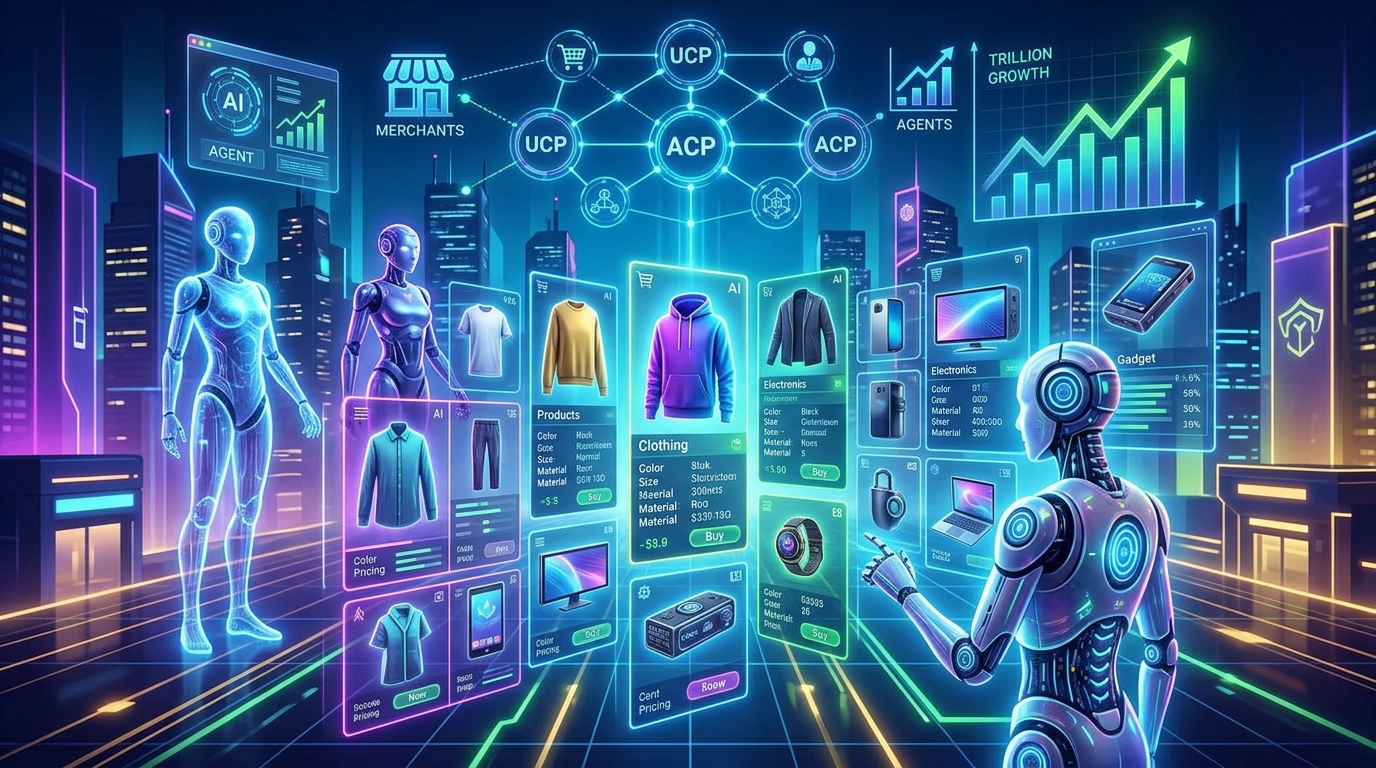
2026's agentic commerce hinges on open protocols that standardize product data for AI agents in ecommerce. Google's Universal Commerce Protocol (UCP), launched in January 2026, is an open-source standard enabling AI agents to discover products, negotiate, and transact across merchants.[5][6] It requires Merchant Center integration with enhanced attributes for AI discovery, turning catalogs into agent-navigable interfaces.
Complementing UCP is the Agentic Commerce Protocol (ACP), co-developed by Stripe and OpenAI in September 2025. ACP mandates a structured product feed (gzip-compressed), checkout API, and payment integration for seamless agent transactions.[7][8] Other protocols like Model Context Protocol (MCP) for data sharing, Agent-to-Agent (A2A) for coordination, and Agent Payments Protocol (AP2) ensure interoperability.[1]
| Protocol | Focus | Key Data Requirements |
|---|---|---|
| UCP (Google) | Discovery & scale | Semantic attributes, real-time inventory APIs, Merchant Center feeds[9] |
| ACP (Stripe/OpenAI) | Transactions | Gzip product feeds, checkout endpoints, signed mandates[10] |
| MCP/A2A | Context sharing | JSON-RPC structured communication[1] |
These standards demand "meaningful" data—beyond basic SKUs to global schemas mapping attributes like color normalization or multilingual specs.[11]
Core Elements of Agent-Ready Product Data
Agentic success starts with granular, standardized product data AI agents ecommerce elements:
-
Standardized Attributes: Use consistent naming (e.g., "Men's Cotton Shirt, Navy, Large") for size, color, material. AI tools auto-map via ontologies like Google's Product Ontology.[12]
-
Semantic Metadata: Embed behavioral data (e.g., "loyalty points eligible," "sustainable sourcing") and context (use cases, comparisons).
-
Real-Time Signals: Availability, pricing, shipping via APIs—critical for dynamic negotiations.
-
Multimodal Enrichment: Images, videos, 360 views with alt-text schemas for visual agents.
Lari Hämäläinen advises investing in "APIs, data interoperability, trust frameworks."[1] Schema.org Product markup (JSON-LD) is baseline, extended for agent protocols.
Actionable Steps to Structure Your Product Data
Follow this framework to prepare your catalog:
-
Audit Current Data: Use PIM tools to scan for gaps—inconsistent attributes, missing metadata. Prioritize high-volume categories via AI query analysis.
-
Standardize Attributes: Map to global standards (GTIN, MPN). Automate normalization with AI classifiers for color/size/material.
-
Implement Schema Markup: Add JSON-LD for Product, Offer, AggregateRating. Example:
<script type="application/ld+json"> { "@context": "https://schema.org", "@type": "Product", "name": "Men's Cotton Shirt", "color": "Navy", "size": "Large", "material": "Cotton", "offers": {...}, "additionalProperty": [{"name": "sustainability", "value": "organic"}] } </script> -
Build Protocol Feeds: For UCP, upload enhanced Merchant Center feeds; for ACP, generate gzip product XML/JSON with endpoints like
/products/search?q=query&agent_id=xyz. -
Expose APIs: RESTful endpoints for inventory (
GET /inventory/{sku}), checkout (POST /checkout), with agent auth (KYA via verifiable credentials).[1] -
Test with Agents: Simulate via OpenAI's ACP sandbox or Google's UCP tools. Monitor visibility in AI responses.
-
Automate Maintenance: Loop in monitoring for data drift.
This process can boost AI visibility 2-5x, per optimization benchmarks.[13]
Leveraging Tools Like BrandKarma for Automation
Manual structuring scales poorly for 50K+ SKUs. BrandKarma automates product data for AI agents in ecommerce by monitoring visibility across ChatGPT, Gemini, etc., discovering buyer queries, and generating schema-enriched content (FAQs, comparisons) via API.[13] It analyzes pages for gaps, adds JSON-LD, and delivers category-level templates populated per SKU—ideal for UCP/ACP feeds.
Integrate BrandKarma's REST API with Shopify or BigCommerce for real-time updates, closing gaps that block agent recommendations. For deeper GEO strategies, see our Generative Engine Optimization for Ecommerce: The 2026 Ultimate Playbook.
Real-World Examples and Decision Framework
Consider a apparel brand: Pre-optimization, AI agents ignored vague "blue shirt" listings. Post-structuring with standardized attributes and UCP feeds, visibility rose 54% in AI queries.[13]
Decision framework:
- Low Maturity: Start with schema markup + PIM cleanup.
- Medium: Add UCP/ACP feeds.
- High: Full API orchestration + BrandKarma automation.
Link to AEO best practices in our AEO Best Practices: Answer Engine Optimization for Online Retailers.
Future-Proofing Your Ecommerce Catalog in 2026
As Forrester predicts a "race to agentic integrations," prioritize trust (KYA), privacy, and multimodal data.[1] Expect Shopify's AI catalog backfill and Adobe's real-time LLM feeds to standardize further.
Lareina Yee urges: "Move first to shape the future."[1] With BrandKarma streamlining GEO and AI visibility—explore How BrandKarma Streamlines GEO and AI Visibility for Ecommerce Sellers—your structured data will dominate agentic commerce.
Ready to agent-proof your catalog? Start auditing today for 2026 wins.
Improve Your AI Visibility
BrandKarma helps B2B companies and industrial distributors get recommended by AI search engines. See how it works or explore our plans.