

Generative Engine Optimization for Ecommerce: The 2026 Ultimate Playbook
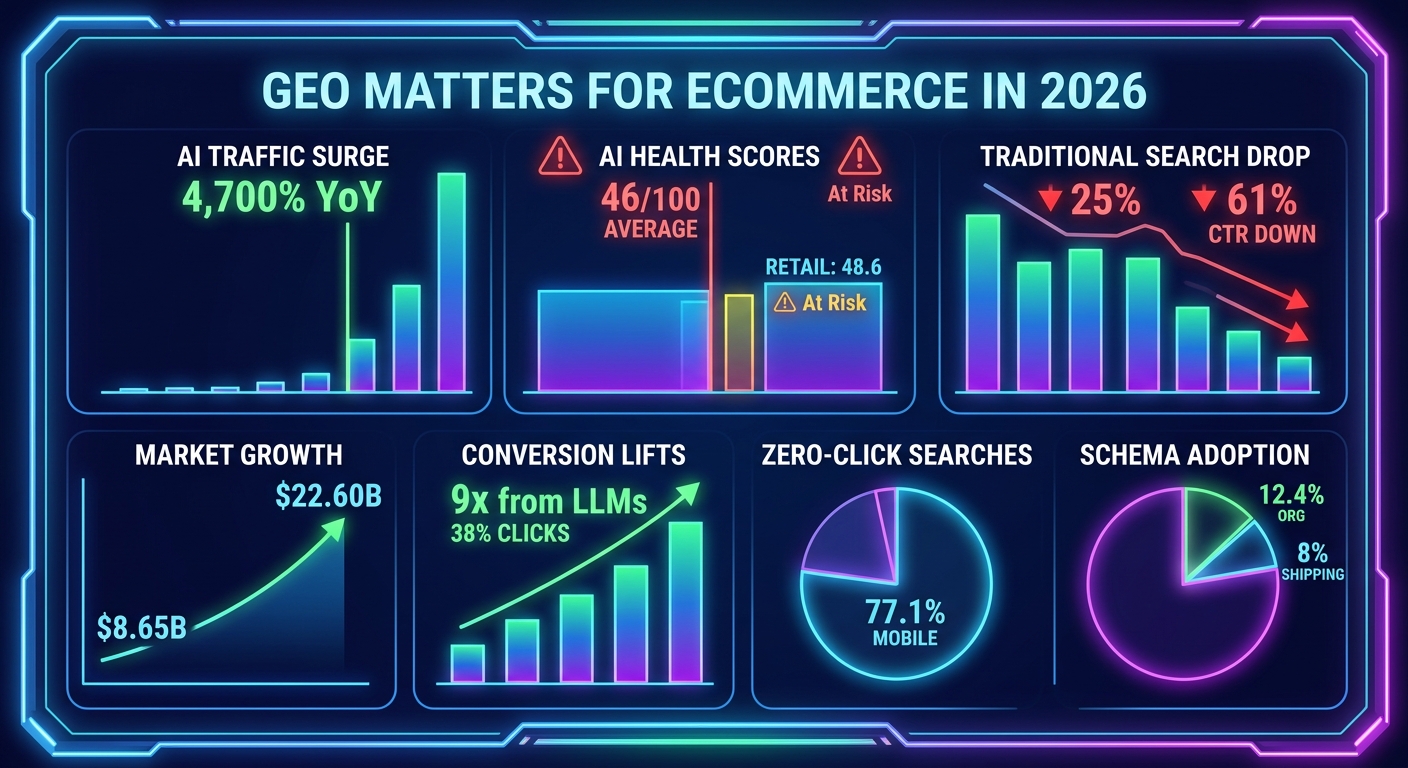
In 2026, the ecommerce landscape is undergoing a seismic shift as generative AI engines like ChatGPT, Perplexity, Google AI Overviews, and Claude redefine how shoppers discover and purchase products. Traditional search engine optimization (SEO) is giving way to Generative Engine Optimization (GEO) for ecommerce, where visibility hinges on being cited, recommended, and synthesized directly into AI responses.[1][2] AI-generated traffic to ecommerce sites surged 4,700% year-over-year through mid-2025, yet 92% of enterprise brands, including retailers, are failing GEO with an average AI Health Score of just 46/100—leaving 62% technically invisible to large language models (LLMs).[3][4] This ultimate playbook equips ecommerce leaders with actionable strategies to dominate AI-driven discovery, boost conversions (which can be 9x higher from LLM traffic), and future-proof their stores.[5]
What is Generative Engine Optimization (GEO)?
Definition: GEO for Ecommerce
Generative Engine Optimization (GEO) is the practice of structuring and optimizing ecommerce content, product data, and brand signals so AI engines select, summarize, and cite your brand in dynamic, conversational responses to shopper queries. Unlike static rankings, GEO ensures your products appear in AI recommendations like "best running shoes for marathons under $100."[2]
GEO emerged as LLMs became primary search interfaces, processing nuanced, multi-step queries beyond keyword matches. For ecommerce, it means preparing product catalogs, pages, and supporting content to feed AI agents that handle everything from research to checkout. Brands cited in AI answers see 38% more clicks and structured content is 28-40% more likely to be referenced.[3]
Why GEO Matters for Ecommerce in 2026
Gartner's forecast of a 25% drop in traditional search volume underscores the urgency: AI chatbots and virtual agents are siphoning queries, with 77.1% of mobile and 58.5% of desktop searches now zero-click.[4][1] Retail's average AI Health Score of 48.6/100 signals "At Risk" status, exacerbated by low schema adoption—only 12.4% of Fortune 1000 have valid Organization Schema, and just 8% of retailers use return/shipping schemas.[4]
Meanwhile, the AI-enabled ecommerce market hit $8.65 billion in 2025 and is projected to reach $22.60 billion by 2032 at a 14.6% CAGR. One in three U.S. shoppers now uses genAI for unfamiliar products, and LLM referral traffic converts 9x better than other channels.[3] DTC brands fare better in open LLMs like ChatGPT (36.8% citation rate) than Google's AI (4.2%), highlighting GEO's role in reclaiming visibility from marketplaces.[4]
Key Takeaway: In 2026, GEO for ecommerce isn't optional—it's survival. With organic CTR down 61% for informational queries post-AI Overviews, brands must optimize for citation to capture high-intent AI traffic.[4]
GEO vs. SEO vs. AEO: A Comparison
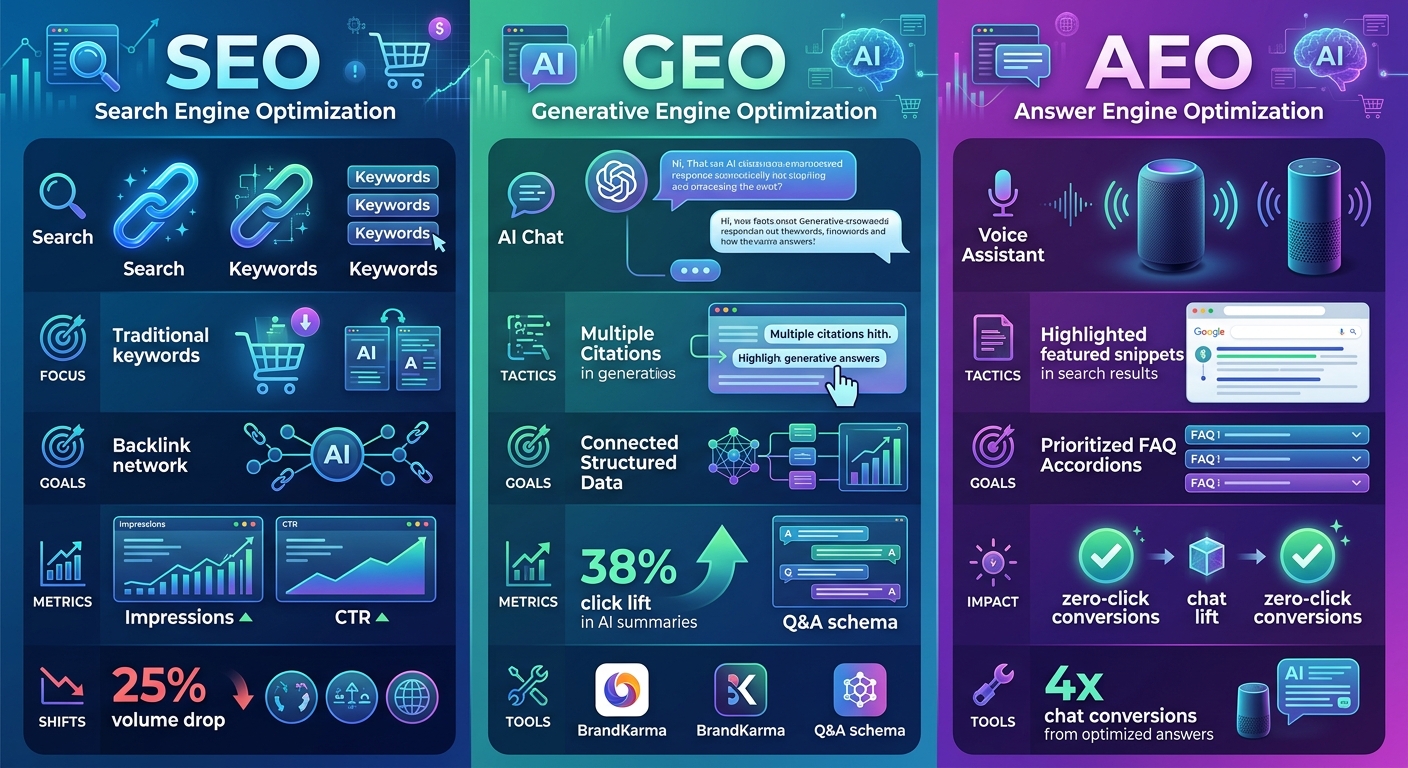
While SEO chases rankings, GEO and Answer Engine Optimization (AEO) target AI synthesis. Here's how they stack up for ecommerce:
| Aspect | SEO (Traditional) | GEO (Generative) | AEO (Answer Engine) |
|---|---|---|---|
| Focus | Keyword rankings in SERPs | Citation in AI-generated responses | Direct answers/snippets in AI/voice |
| Core Tactics | Backlinks, on-page keywords | Structured data, Q&A, entity signals | Concise FAQs, schema for featured info |
| Ecommerce Goal | Drive clicks from blue links | Brand recommendations in AI shopping | Zero-click conversions via summaries |
| Metrics | Impressions, CTR, rankings | AI citations, visibility score, conversions from LLMs | Snippet win rate, position zero |
| 2026 Impact | 25% volume drop | 38% click lift from citations | 4x conversion via AI chat |
| Tools Needed | Ahrefs, SEMrush | BrandKarma, schema validators | FAQ schema, content briefs[3] |
GEO builds on SEO foundations but prioritizes LLM legibility: entity identity, technical parsability, and information gain.[4] For deeper AEO tactics, see our guide on AEO Best Practices: Answer Engine Optimization for Online Retailers.
Core Strategies for GEO in Ecommerce
1. Master Structured Product Data
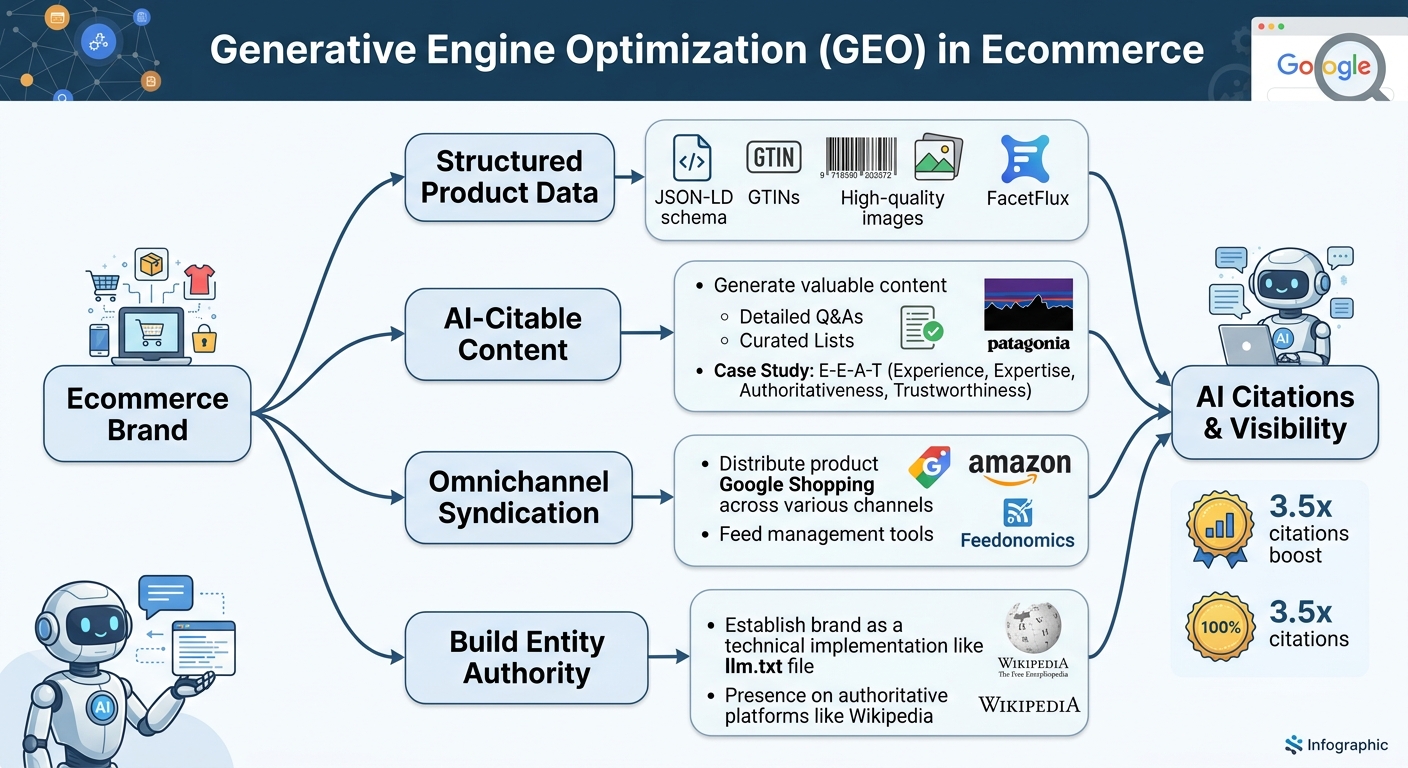
AI agents crave parseable data. Start with JSON-LD schema for Product, Offer, AggregateRating, FAQPage, and Organization entities—linking to Knowledge Graph IDs boosts ChatGPT citations 3.5x.[4][2]
Prepare feeds with accurate GTINs, pricing, availability, high-res images (with alt text), and videos/transcripts. Tools like FacetFlux excel here, transforming raw catalogs into AI-ready formats with facets for variants, reviews, and shipping—essential for agentic commerce. Link this prep to our pillar Structuring Product Data for AI Agents and Agentic Commerce in 2026.
Audit pages weekly: missing images or outdated stock kills citations.[1]
2. Craft AI-Citable Content
Shift to "answer-first" formats: conversational Q&As, lists, tables, and sourced stats on product pages. Use real customer language from support tickets and forums—Patagonia and REI dominate AI recs for jackets via authentic stories and structured FAQs.[5]
Incorporate E-E-A-T: expert quotes, recent citations, human-edited AI drafts. For editorial mastery, read Crafting Editorial Content That Dominates AI Overviews and ChatGPT Responses.
Key Takeaway: Structured Q&A on product pages turns zero-clicks into recommendations—prioritize authenticity over keyword stuffing.[5]
3. Implement Omnichannel Syndication
Syndicate consistent data across Google Shopping, Meta, TikTok, and Amazon. Tools like Feedonomics ensure parity, but automate with BrandKarma for AI-specific monitoring.
4. Build Entity Authority
Claim your brand in LLMs via llm.txt files, Wikipedia edits, and high-authority mentions. 84% of ecommerce firms prioritize AI, yet most block crawlers—don't.[3]
Technical Foundations for GEO Success
Server-side rendering is critical—AI agents struggle with JS-heavy sites hiding variants/reviews.[6] Validate schema with Google's Rich Results Test, add return/shipping details (only 8% do), and use composable architectures for reusable blocks.
For Shopify/WooCommerce, apps handle JSON-LD; headless setups shine for parseability.[2]
Automating GEO with BrandKarma and FacetFlux
BrandKarma revolutionizes GEO for ecommerce by monitoring visibility across ChatGPT, Perplexity, Google AI, and Claude—tracking purchase-driving prompts, sentiment, and competitor citations.[7] It generates content briefs for blogs, guides, and FAQs proven to earn citations, with weekly reports on trends.
Pair with FacetFlux for product data prep: automate faceted navigation, GTIN enrichment, and schema generation at scale. Full BrandKarma automation handles audits, content creation, and optimization loops. Learn more in How BrandKarma Streamlines GEO and AI Visibility for Ecommerce Sellers.
Measuring and Iterating on GEO Performance
Track AI citations (top 5 domains claim 38%), visibility scores, assisted conversions, and LLM referral traffic. Tools like BrandKarma provide benchmarks; A/B test Q&As and schemas.
Expect 70% higher ROI from AI-optimized SEO elements.[3]
Real-World Case Studies and Wins
Patagonia/REI: Structured stories yield consistent AI recs.[5] Enterprise multilingual GEO: +200% traffic via cultural adaptation.[8] Gorgias hit 92% visibility via targeted prompts. DTC brands optimizing feeds see 28-40% citation lifts.
Future Trends in GEO for Ecommerce
Agentic AI (33% enterprise adoption by 2028) demands flawless data for autonomous shopping. Multilingual GEO, voice/AR integrations, and paid AI placements loom. GEO agencies rise, but in-house tools like BrandKarma lead.[3][9]
Key Takeaway: GEO evolves with AI—prioritize localization, agents, and continuous audits to stay ahead.
FAQ: GEO for Ecommerce Essentials
What is the difference between GEO and SEO for ecommerce?
GEO optimizes for AI citations via structure and authority, while SEO targets rankings. They coexist, but GEO drives 9x better conversions in 2026.[5]
How do I implement schema for GEO?
Use JSON-LD for Product, FAQ, and Org schemas. Validate with Google's tool—boosts citations 3.5x.[4]
What tools are best for GEO in ecommerce?
BrandKarma for monitoring/automation, FacetFlux for data prep, Surfer/NeuronWriter for content. Free: llm.txt, schema testers.[7]
Why are most ecommerce sites invisible to AI?
Low schema (8% use shipping), JS barriers, poor entity signals—62% technically invisible.[4]
How does BrandKarma automate GEO?
Tracks AI prompts, generates citable content, reports competitor gaps—streamlining visibility.[7]
Can GEO replace SEO?
No—GEO complements it for AI era dominance.
What's the ROI of GEO for ecommerce?
38% click lift, 4x chat conversions, up to 300% revenue from AI recs.[3]
How to start GEO today?
Audit schemas, add FAQs, monitor with BrandKarma—quick wins in weeks.
Mastering GEO for ecommerce positions your brand at the forefront of AI commerce. With structured data via FacetFlux and full automation from BrandKarma, reclaim visibility and drive 2026 growth. Get started with BrandKarma today.
Improve Your AI Visibility
BrandKarma helps B2B companies and industrial distributors get recommended by AI search engines. See how it works or explore our plans.