

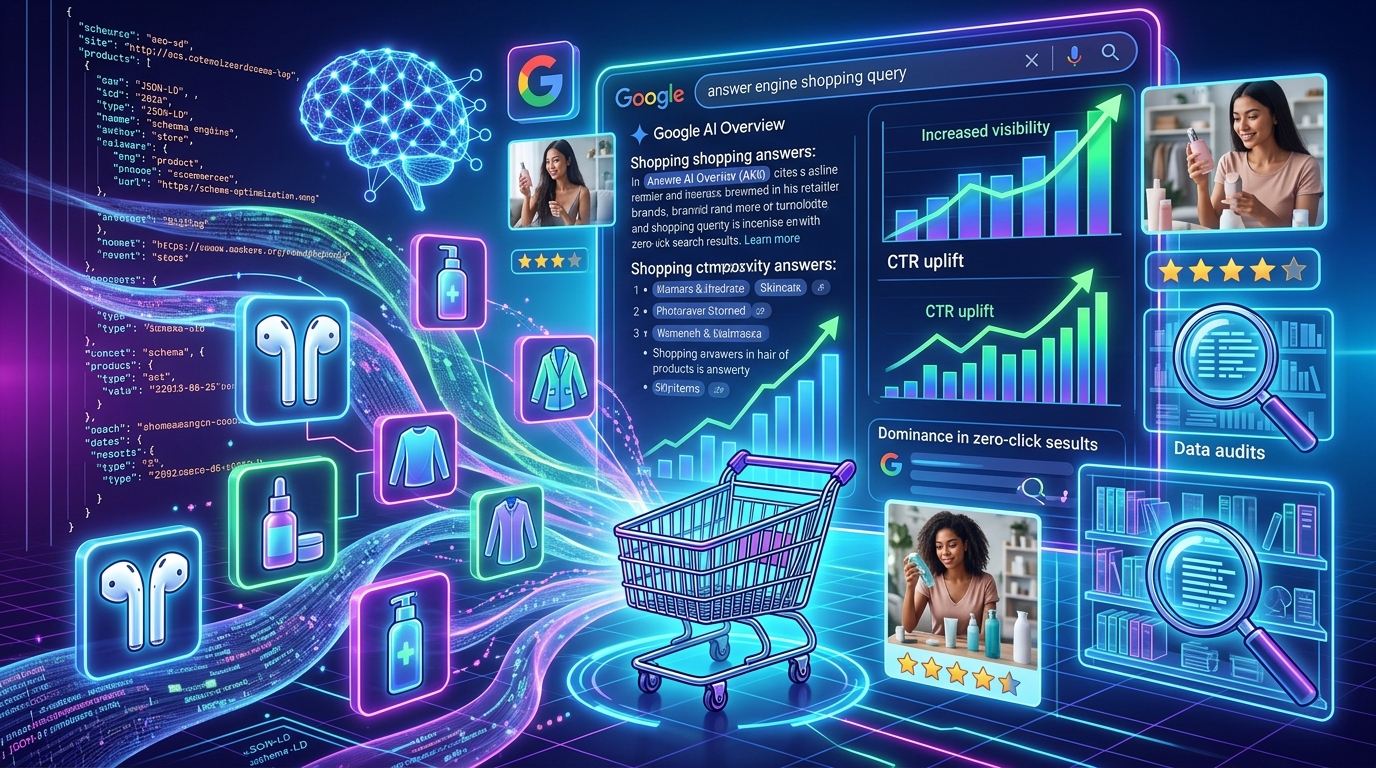
AEO Best Practices: Answer Engine Optimization for Online Retailers
Answer Engine Optimization (AEO) for ecommerce is about structuring your product data, content, and customer signals so AI systems like Google AI Overviews, ChatGPT, and Gemini cite your brand as the authoritative source for shopper queries. For online retailers, effective AEO ecommerce optimization means implementing granular schema markup, syndicating user-generated content (UGC), and auditing your digital presence to capture high-intent traffic amid rising zero-click searches.[1][2]
AI Overviews now trigger on 18.57% of commercial searches, averaging over 1,200 pixels tall and pushing organic results below the fold—resulting in up to 65% drops in organic CTR.[1] With nearly 60% of Google searches zero-click and top results cited in AEO answers only 8% of the time, retailers must adapt.[3] Here's a focused playbook of six best practices, drawn from proven tactics that boost visibility and conversions.
Why Prioritize AEO Ecommerce Optimization in 2026
Gartner's forecast of a 25% search volume drop by 2026 underscores the shift to AI chatbots and agents.[3] For retailers, 22% of shoppers already use AI for product research, rising to 60% in physical stores—a hybrid trend demanding consistent, contextual product data.[2] Proper AEO ecommerce optimization via schema can lift CTR by 40%, while UGC drives 161% higher conversions and 137% purchase likelihood from customer photos.[1]
94% of CMOs plan increased AEO investments this year, prioritizing structured data and AI content generation.[4] This aligns with our broader topical cluster on GEO and AEO strategies, where structuring product data for AI agents complements these practices for agentic commerce.
Best Practice 1: Start with an AI Content and Entity Audit
Begin AEO ecommerce optimization by auditing how LLMs perceive your brand. This isn't a checklist—it's a strategic review of your domain's entity architecture, product data consistency, and LLM readiness.[1]
Actionable Steps:
- Query AI tools with your top product searches (e.g., "best wireless earbuds under $100 for running") and note citations, hallucinations, or gaps.
- Map content to buyer intent: Assess PDPs for attributes like "intended purpose/role" (e.g., "for workouts") and "event context/use case" (e.g., "sweat-resistant during marathons").[2]
- Use tools like Google's Rich Results Test or Schema Markup Validator to scan for inconsistencies across your catalog.
Example: A skincare retailer audits and finds AI summarizing competitors' vegan claims but omitting theirs—fix by standardizing attributes site-wide.
As Yotpo's Amit Bachbut notes, "An AI audit... tells us exactly where we stand and how to prepare our data for the future."[1]
Best Practice 2: Implement Granular JSON-LD Schema Markup
Treat structured data as your "digital shelf space" in AI engines. Go beyond basic Product schema to encode business logic like pricing tiers, variants, and loyalty eligibility.[1]
Key Schema Types for Retailers:
- Product + Offer: Name, price, availability, SKU, images.
- FAQPage/QAPage: On PDPs for "Is this cruelty-free?" or size guides.
- Review/AggregateRating: Integrate UGC for trust signals.
- BreadcrumbList/Organization: Contextual navigation and brand authority.
Actionable Steps:
- Add JSON-LD to PDPs via Shopify apps or WooCommerce plugins—validate with Google's tool.
- Include dynamic elements: e.g.,
{ "loyaltyTier": "Gold members get 20% off" }. - Test multi-modal: Pair with high-res customer photos for visual AI processing.
This setup ensures AI extracts facts accurately, reducing hallucinations and boosting inclusion in answers.
Best Practice 3: Syndicate UGC and Reviews for Algorithmic Consensus
AI infers trust from customer consensus—syndicate reviews across platforms for third-party validation.[1] Products with 10+ reviews see 53% conversion uplifts; smart prompts yield 4x richer feedback.
Actionable Steps:
- Use SMS requests (66% higher conversion than email) via Klaviyo for detailed reviews on fit, materials.
- Embed AggregateRating schema and photo UGC on PDPs.
- Syndicate to Reddit, Trustpilot—monitor for AI citations.
Eli Weiss of Yotpo emphasizes: "Generative engines infer trust directly from customer consensus."[1]
Link this to crafting editorial content that dominates AI overviews, where UGC fuels conversational authority.
Best Practice 4: Craft Conversational Q&A Content for PDPs and Pillars
Shift to natural language mirroring shopper prompts like "best eco-friendly lipstick for dry skin."[3] PDPs become answer hubs with expandable Q&A.
Actionable Steps:
- Map funnel stages: Awareness (FAQ blogs), Consideration (PDP comparisons), Purchase (shipping details).
- Use question headings: H2 "Does this run true to size?" with schema-backed answers.
- Build pillar pages/clusters: Link category hubs to PDPs for topical depth.[2]
For Shopify users, apps automate Q&A generation from buyer queries.
Best Practice 5: Target Long-Tail Prompts and Multi-Modal Optimization
Optimize for complex queries with variables (price, compatibility). Encourage UGC photos/videos for visual AI.
Actionable Steps:
- Analyze AI query tools for long-tails in your niche.
- Add "use case" text: "Perfect for gym sessions—sweat-proof up to 2 hours."
- Compress visuals for fast loading, tag with descriptive alt text.
This drives 6x higher conversions from AI traffic versus traditional search.
Best Practice 6: Monitor, Automate, and Iterate with AI Tools
Track "share of voice" in AI answers using platforms like BrandKarma, which monitors visibility across ChatGPT/Gemini, generates schema/FAQs via API, and benchmarks competitors—delivering 5x more recommendations in days.[5]
Decision Framework:
| Maturity Level | Focus | Metrics |
|---|---|---|
| Beginner | Audit + Schema | Schema validity, AI mentions |
| Intermediate | UGC + Q&A | Citation rate, conversions from AI |
| Advanced | Automation | Share of voice, visibility score |
Quarterly audits prevent gaps. See How BrandKarma Streamlines GEO and AI Visibility for full automation.
Implementation Roadmap for Retailers
- Week 1-2: Audit + schema on top 20 SKUs.
- Month 1: UGC campaigns + PDP Q&A.
- Ongoing: Monitor with BrandKarma API integration.
41% of consumers trust AI recommendations over paid search—claim your spot.[6] Paired with our 2026 GEO playbook, these practices build unassailable AI authority for ecommerce success. Start your audit today.
Improve Your AI Visibility
BrandKarma helps B2B companies and industrial distributors get recommended by AI search engines. See how it works or explore our plans.