
Treat schema as corroboration, not an AI citation tactic
Treat schema as corroboration, not an AI citation tactic
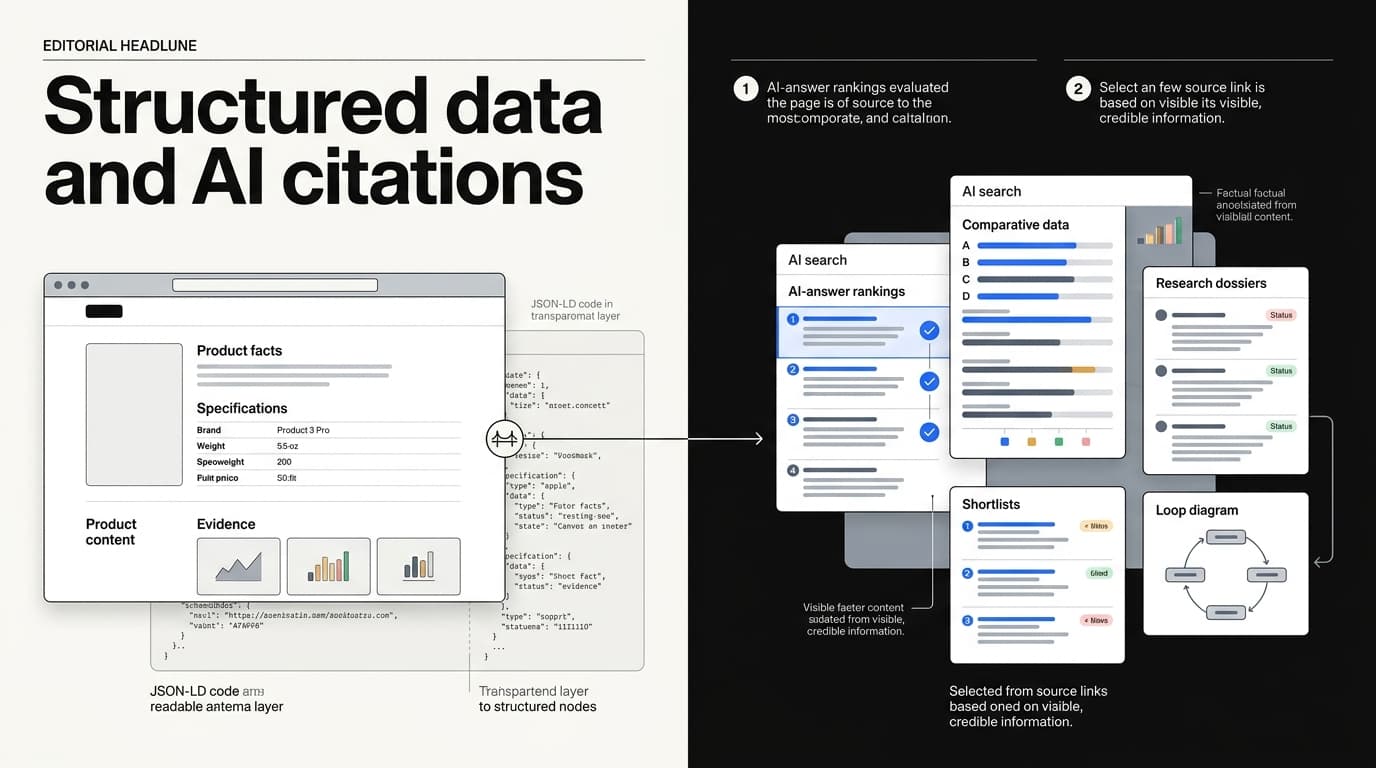
Schema markup is best understood as a way to corroborate visible facts, not as an independent driver of generative recommendations. Google says that no special schema.org markup is required for eligibility in AI Overviews or AI Mode. Research published by Ahrefs also found no causal lift from adding JSON-LD to pages. So, does schema markup improve AI citations? The evidence supports a narrower conclusion: valid structured data can help represent entities and page facts clearly, but it does not, by itself, demonstrate that an AI system will cite or recommend a brand.
The reality of schema and generative AI
The appeal of schema is easy to understand. Structured data describes products, organizations, articles, and other entities in a standardized format. It may therefore seem reasonable to assume that adding more markup will make a page more attractive to generative systems. That assumption confuses clearer representation with evidence of improved retrieval.
Google’s AI-search documentation, dated July 10, 2026, states that no special schema.org markup is required for eligibility in AI Overviews or AI Mode. The guidance also says that an llms.txt file, artificial content chunking, AI-specific rewriting, and special schema are unnecessary for AI feature visibility. These statements do not make technical SEO irrelevant. They do mean that Google does not document a special schema requirement or markup pathway that guarantees inclusion in its AI features.
Structured data still has a legitimate role. Google says markup must match the visible content of the page. Markup that does not correspond to visible page content violates its structured-data policies. Schema should therefore describe facts that users can verify on the page. It should not be used to insert unsupported product claims, hidden attributes, or additional context intended solely for an AI system.
This distinction matters when teams decide where to spend technical resources. Improving page clarity, maintaining accurate product information, and making important evidence easy to find are defensible priorities. Adding increasingly complex schema relationships without improving the underlying content is not an established route to generative visibility.
What the data says about whether schema markup improves AI citations
The strongest evidence comes from a matched study by Ahrefs. AI-cited pages were almost three times more likely to have JSON-LD than pages that were not cited. That association could suggest that schema improves AI visibility, but it could also reflect the characteristics of sites that already invest in technical SEO. Larger, better-maintained, and more authoritative websites may be more likely to use structured data and more likely to be cited for other reasons.
Ahrefs therefore compared pages that added JSON-LD with a control group. In the study of 1,885 pages, which Ahrefs published on May 11, 2026, Google AI Overview citations fell by 4.6% relative to the control group after schema was added. Changes in citations from Google AI Mode and ChatGPT were statistically indistinguishable from zero. The date refers to the publication of the study, not to when the pages themselves were published.
The result does not show that schema reduces visibility in every context. It shows that, in this matched study, adding JSON-LD alone did not produce the positive causal effect that some schema advocates expect. The most credible interpretation is that structured data can appear alongside strong AI visibility without being the reason for it.
That is the difference between correlation and causation. A site may have accurate schema, strong editorial content, external mentions, and a recognized brand at the same time. If it is cited, the citation cannot automatically be attributed to the schema. The practical question—does schema markup improve AI citations?—should therefore be separated into three questions: Is the markup valid? Does it help describe the page? Does adding it change how often AI systems cite the page? The available evidence supports the first two, but does not establish the third.
Direct retrieval favors visible content
A searchVIU experiment cited by Ahrefs provides another reason not to treat hidden markup as a citation tactic. When ChatGPT, Claude, Perplexity, Gemini, and Google AI Mode retrieved information from a live URL, the systems extracted visible HTML while ignoring JSON-LD, hidden Microdata, and hidden RDFa in that experiment.
This finding has a practical implication: information that matters to a buyer should be stated clearly in the page’s visible content. Product specifications, compatibility details, limitations, evidence, and use cases should not exist only in a JSON-LD block. Structured data can reinforce a fact that is already presented, but it is not a reliable substitute for presenting the fact itself.
The experiment should not be overstated. It does not prove that every AI system will always ignore every form of structured data in every retrieval context. It does show that direct retrieval can prioritize visible HTML, so organizations should not assume that hidden schema will carry important information into an AI-generated answer.
For technical products, this principle is especially relevant. A procurement professional may ask an assistant about materials, tolerances, integrations, or implementation requirements. If the answer is available only in hidden markup, the page has not made that information directly available in its visible content. Clear explanations, supported by credible external references where appropriate, provide a stronger foundation for retrieval.
Traditional SEO and AI visibility are different surfaces
The question of whether schema markup improves AI citations is also tied to a broader misconception: that a strong traditional ranking automatically produces strong AI visibility. Traditional search performance may matter, but the relationship is neither simple nor settled.
Ahrefs reported that only 6.82% of ChatGPT results overlapped with Google’s top 10 organic results, while 28.3% of ChatGPT’s most-cited pages had zero organic visibility in Google Search. Google AI Overviews and Google AI Mode also showed limited overlap. Ahrefs reported a 13.7% URL overlap between the two surfaces; an SE Ranking study reported a 10.7% URL overlap and a 16% domain overlap.
Other research points in a different direction on the relationship between rankings and citations. Ahrefs reported that 76.1% of cited URLs ranked in Google’s top 10. BrightEdge reported that about 17% of citations came from the organic top 10, while AirOps reported that roughly 60% of AI Overview citations came from URLs outside the top 20. These findings use different methods and should not be treated as interchangeable. Together, they show why no single ranking rule explains AI citations.
Schema belongs in the same context. It may support a page’s technical quality and entity description, but it does not allow a brand to bypass the content, reputation, and retrieval factors that differ across platforms. A page that is well marked up but vague, outdated, or unsupported is unlikely to become a preferred source simply because its JSON-LD is comprehensive.
Align structured data with verifiable facts
The useful role of schema is corroboration. It maps visible information to standardized entities and can help maintain consistency across a site. That role is valuable for technical governance, but it should not be confused with a direct generative-ranking signal.
A sound implementation follows a few principles:
- Mark up facts that are visible and verifiable on the page.
- Keep product, organization, and editorial properties accurate and current.
- Do not add claims to schema that the page does not support.
- Treat structured data as complementary to visible explanations, not a replacement for them.
- Measure citations and brand mentions separately.
The last point matters because an AI brand mention and an AI citation are different outcomes. A brand mention names a company, product, or service in a generated answer. An AI citation links to a specific source page. A page can receive one without receiving the other, so reporting should not combine them into a single visibility metric.
Evidence outside the company’s own website may also matter. Data presented at Ahrefs Evolve identified branded web mentions as the strongest reported predictor of AI Overview citations, with a 0.664 correlation. An eMarketer study reported that 85% of brand mentions in AI answers originated from third-party pages rather than owned domains. These findings describe associations and source patterns, not a guaranteed formula for winning recommendations. They suggest that visibility work should include accurate, useful information across relevant external sources rather than focus exclusively on first-party schema.
The research leaves important questions unresolved. It does not establish how much of the association between branded mentions and AI visibility is causal, or which external source types are most influential for a particular category. It also does not establish how much a company’s AI exposure contributes to qualified pipeline rather than merely receiving last-click credit for users who were already inclined to buy.
Ultimately, does schema markup improve AI citations directly? The available evidence does not show a direct causal lift from adding JSON-LD. Schema is worth maintaining when it accurately corroborates visible content and supports sound site architecture. It should not be presented as an AI citation lever. For generative visibility, the stronger priorities are clear and useful on-page information, credible external corroboration, and measurement that accounts for differences between platforms and repeated searches.
Sources
- AI Search Statistics 2026: The Numbers Marketers Your Marketing team Needs this Month
- We Tracked 1,885 Pages Adding Schema. AI Citations Barely Moved.
- Schema Markup for AI Citations: The 4-Type Priority Stack That Gets You Cited by ChatGPT, Perplexity, and Gemini
- Google's Guide to Optimizing for Generative AI Features on Google Search | Google Search Central | Documentation | Google for Developers
- General Structured Data Guidelines | Google Search Central | Documentation | Google for Developers
Published through BrandKarma
Christoph Menge built the product. This article was researched and published through it, and delivered over the same public content API your developers would call. About · How it works · Pricing.
See what AI says about you
If this article named a gap you already feel, request the report. We run your top categories across ChatGPT, Perplexity and Gemini and send it within 48 hours.
See what AI says about you