
AI recommendations rely on an evidence map, not a better brand page
AI recommendations rely on an evidence map, not a better brand page
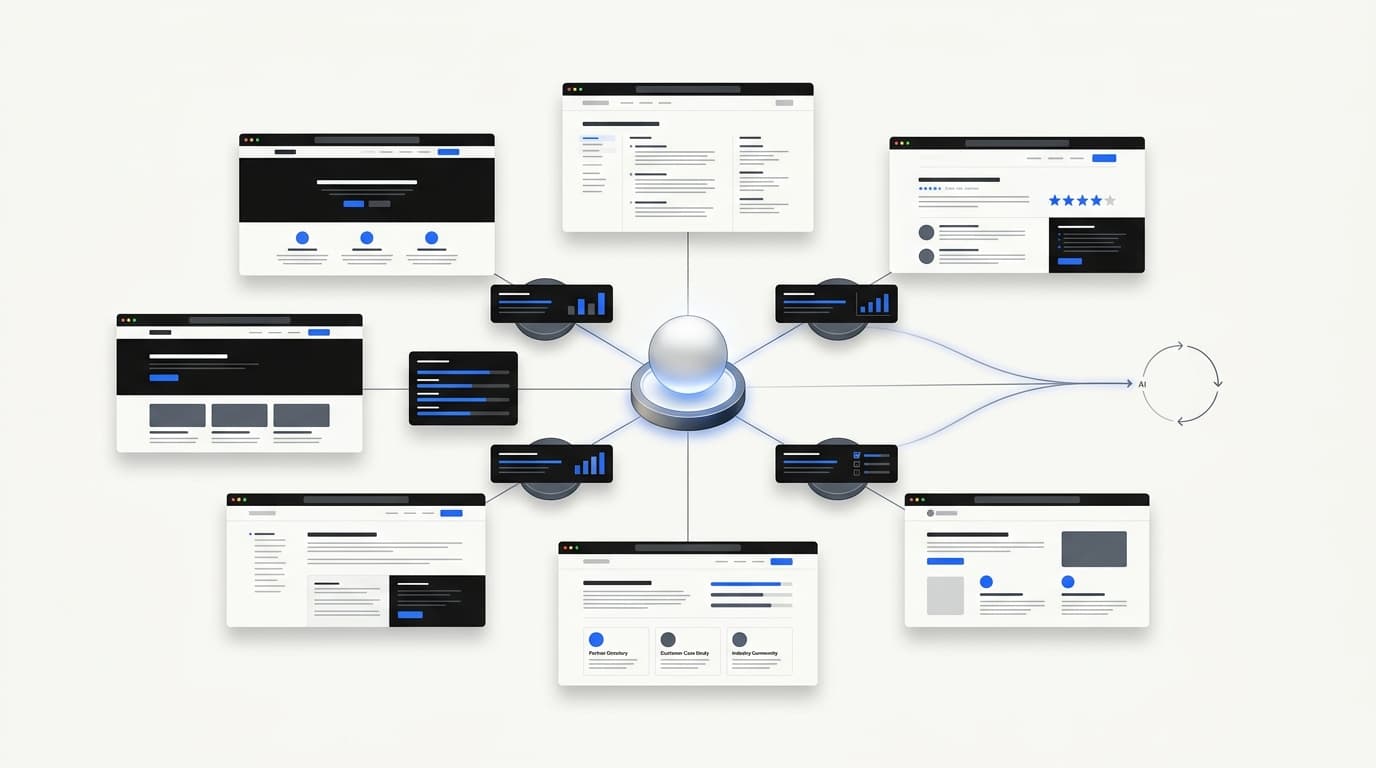
Brand entity optimization for AI search is the practice of making a company’s facts, products, and capabilities clear and verifiable across the web. It extends beyond improving a brand’s own website. When an AI system generates a recommendation, it may draw on company pages, review platforms, editorial comparisons, technical documentation, directories, and other sources. A strong recommendation therefore depends not only on what a company says about itself, but also on whether relevant external sources support the same picture.
The practical goal is not to place one page at the top of a results list. It is to build an evidence map: a network of consistent, accessible information that helps AI systems identify the company, understand its offer, and distinguish it from alternatives.
Understanding brand entity optimization for AI search
Traditional search rewarded many familiar signals of a strong website: relevance to the query, technical accessibility, useful page content, and authority from links. Those signals remain relevant, but generative search introduces a different outcome. A user may ask an AI system to compare suppliers, explain an integration, or recommend a product for a particular use case. The system can then synthesize information from several sources instead of returning only a ranked list of pages.
Definition: Brand entity optimization for AI search is the cultivation of accurate, consistent, and verifiable information about a company across its own properties and relevant third-party sources, so that AI systems can identify and evaluate the brand in generated answers.
A company’s homepage remains important. It is often the clearest place to state product names, specifications, service areas, integrations, policies, and company facts. But a homepage is a self-published source. For recommendations, an AI system may also look for corroboration in independent reviews, industry publications, technical communities, partner directories, and other relevant discussions.
This distinction matters especially in B2B markets. A procurement professional might ask which distributor supports a particular integration or which supplier is suitable for a demanding operating environment. The answer may depend on facts distributed across product documentation, customer evidence, review profiles, and specialist publications. If those sources disagree, omit important information, or fail to mention the brand in the relevant context, the company’s website may not be enough to establish a clear entity.
AI visibility should not be treated as a single form of search visibility. Google AI Overviews, Google AI Mode, and standalone systems such as ChatGPT are different surfaces. Research cited in the cluster dossier found only 13.7% URL overlap between Google AI Overviews and AI Mode in one Ahrefs study. An SE Ranking study reported 10.7% URL overlap and 16% domain overlap. Ahrefs also reported that only 6.82% of ChatGPT results overlapped with Google’s top 10 organic results, while 28.3% of ChatGPT’s most-cited pages had no organic visibility in Google Search.
These findings do not make traditional SEO irrelevant. They show that a top organic position is not a guarantee of inclusion in an AI-generated answer. Brand entity optimization for AI search must therefore account for multiple retrieval and recommendation environments.
The disconnect between traditional rankings and AI citations
The relationship between conventional rankings and AI citations is unsettled. Different studies have produced materially different results. Ahrefs reported that 76.1% of cited URLs ranked in Google’s top 10. BrightEdge reported that about 17% of citations came from the organic top 10, while AirOps reported that roughly 60% of AI Overview citations came from URLs outside the top 20.
These figures should not be collapsed into one definitive benchmark. They may reflect differences in platforms, query sets, sampling, citation definitions, and measurement methods. The reasonable conclusion is narrower: traditional search performance can help, but it does not fully explain which sources appear in generated answers.
The same caution applies to the prevalence of AI Overviews. Data summarized by Omnibound attributed an estimate of 82% of B2B Technology queries in February 2026 to BrightEdge, compared with 36% in February 2025. Google stated in February 2026 that AI Overviews appeared on roughly 50% of US queries. Other reported estimates included approximately 48–50% of US queries, approximately 33% of queries, and 25.11% in Conductor’s Q1 2026 data. These results may differ by market, device, query panel, and feature-detection methodology. They should not be presented as interchangeable measures of market adoption.
The difference between search ranking and AI recommendation can be summarized as follows:
| Metric category | Traditional search dynamics | AI system dynamics |
|---|---|---|
| Primary outcome | Visibility for an owned URL in search results. | A brand mention, source citation, or recommendation in a generated answer. |
| Evidence base | Page relevance, technical signals, and authority. | A mixture of owned and third-party sources retrieved or used by the system. |
| Measurement | Rankings, impressions, clicks, and conversions. | Prompt-level visibility, mentions, citations, answer context, and downstream actions. |
| User interaction | Often a click to an individual result. | The answer may satisfy part of the user’s intent before a click occurs. |
For this reason, a brand should measure more than whether its homepage ranks well. It should examine whether the brand is named for important prompts, which pages are cited, whether cited sources actually support the recommendation, and whether the result changes across platforms and repeated runs.
How third-party mentions contribute to AI visibility
The evidence map is built from more than citations to a company’s own domain. It includes the surrounding information that helps an AI system assess whether a claim is supported. A review profile may describe usability. A technical publication may discuss performance. A partner directory may confirm an integration. A customer case study may document a use case. Each source contributes a different kind of evidence, provided that the information is accurate and relevant.
Data presented at Ahrefs Evolve identified branded web mentions as the strongest reported predictor of AI Overview citations, with a 0.664 correlation. This is an association, not proof that increasing mentions alone causes more citations. Existing brand demand, editorial attention, links, and other forms of authority may influence both the number of mentions and AI visibility.
An eMarketer study reported that 85% of brand mentions in AI answers originated from third-party pages rather than owned domains. Other datasets have reported that brands represented 52.5% of citations overall and 59.8% of AI Overview citations. These figures should not be treated as direct contradictions without examining what each study counted. A citation-source study may ask which type of page was linked. A brand-mention study may ask where the brand named in the answer was discussed. A page can be cited for a technical specification without being the source of the broader recommendation. Brand mentions, citation sources, and named recommendations are related but distinct outcomes.
Presenc AI’s April 2026 study of 84,000 queries found that brand and company websites accounted for 31% of AI Overview citations, up from 26% in Q1 2025. This result reinforces the need to distinguish between studies rather than declare that owned or third-party sources always dominate.
Buyer research also suggests that AI-generated recommendations can influence consideration. G2’s April 2026 survey of 1,076 B2B software buyers found that 51% started research in an AI chatbot more often than on Google, 71% used AI chatbots during research, 69% changed their intended vendor choice because of an AI chatbot recommendation, and 33% bought from a vendor they had not previously known.
In the same research, 45% of respondents described citations from software review sites as the single most confidence-building element in an AI response, while 83% said they felt more confident in their purchase after using AI chatbots. These figures describe survey responses, not a universal causal effect for every category. They nevertheless show why third-party evidence deserves attention in B2B purchasing journeys.
For a company with a large catalog, the operational challenge is consistency. Product names, specifications, compatibility information, and service claims must remain accurate across the company website and the external sources that discuss the products. Programmatic systems may help with monitoring and data management, but they cannot substitute for editorial judgment about which sources are credible or whether a claim is properly supported.
Technical fundamentals and the role of schema
Technical accessibility still matters. Clear headings, descriptive page copy, accessible content, stable URLs, and explicit product facts make a page easier for people and automated systems to understand. The supplied research does not establish that a particular crawler-access configuration will produce commercial visibility, so access decisions should also reflect a company’s security, privacy, and model-training policies.
Recency may affect retrieval. ConvertMate’s AI Visibility Study of 80 million citations found that content updated within 30 days received 3.2 times more AI citations than older content. Separately, Seer Interactive found that 65% of AI bot hits targeted content published within the past year. These findings support regular review of important pages, but they do not establish that every page should be updated on an arbitrary schedule. Updates should reflect genuine changes, corrections, new evidence, or clarified explanations.
Page structure is another consideration. Growth Memo reported that 44.2% of LLM citations came from the first 30% of a webpage, while Search Engine Land found that 52.2% of AI-cited passages contained original, owned data. Important specifications, qualifications, and evidence should therefore not be hidden at the end of a long page. Content should state the essential fact clearly and provide enough context to prevent it being misunderstood.
Schema markup requires a measured approach. Google’s AI-search documentation says that no special Schema.org markup is required for eligibility in AI Overviews or AI Mode. Google also states that llms.txt, content chunking, AI-specific rewriting, and special schema are unnecessary for AI feature visibility. Structured data should describe facts that are visible and verifiable on the page. Markup that does not match visible content can violate Google’s structured-data policies.
Research from Ahrefs found an association between JSON-LD and AI-cited pages, but no causal lift from adding it. In a matched study of 1,885 pages that added schema, Google AI Overview citations fell 4.6% relative to controls. Changes in AI Mode and ChatGPT citations were statistically indistinguishable from zero.
A searchVIU experiment cited by Ahrefs found that ChatGPT, Claude, Perplexity, Gemini, and Google AI Mode extracted visible HTML during direct retrieval while ignoring JSON-LD, hidden Microdata, and hidden RDFa. This does not mean valid schema has no value in web publishing. It means schema should not be treated as a standalone method for obtaining AI citations. Visible, accurate, well-structured information remains the safer foundation.
Measuring the return on generative optimization
AI visibility does not yet have a settled measurement standard. A 2026 review characterized GEO terminology, metrics, and evidence standards as heterogeneous. Separate measurement research described visibility as a distribution across repeated prompt–platform–time observations rather than a one-time rank.
A useful measurement framework separates at least four outcomes:
- Brand mention: the generated answer names the company, product, or service.
- Unlinked mention: the brand is named without a clickable source link.
- Citation: the system links to a specific source page.
- Recommendation context: the brand is presented as relevant or suitable for the user’s stated need.
These outcomes should be recorded separately. A Semrush study with Kevin Indig logged 3,981 domain appearances from 115 prompts across four AI systems and 14 countries. It classified 61.7% of outcomes as “ghost citations,” where a site appeared in a source list but the brand was not named in the answer. In the study, ChatGPT cited domains in 87% of appearances but explicitly named the brand in only 20.7%.
Traffic is another imperfect indicator. Conductor’s 2026 AEO/GEO Benchmarks reported that AI referral traffic averaged 1.08% of total website traffic across industries, grew about 1% month over month, and was generated by ChatGPT in 87.4% of cases in that benchmark. These figures describe average referral traffic, not total influence. An AI answer may affect a later branded search, direct visit, or sales conversation without producing an immediately identifiable referral.
Several studies reported higher conversion rates for AI referrals. Ahrefs reported that AI-search visitors produced 12.1% of signups while accounting for 0.5% of total traffic, describing a reported 23x conversion-rate premium over standard organic traffic. Similarweb reported an 11.4% conversion rate for AI referral traffic versus 5.3% for organic search, and Adobe Digital Insights reported that AI-referred traffic converted 42% better than non-AI traffic.
These results are encouraging but should not be treated as guaranteed incremental revenue. High-intent visitors may already be predisposed to convert, and attribution systems may miss later effects. A sound evaluation should compare prompt visibility with qualified pipeline, assisted conversions, branded search, direct traffic, and sales feedback rather than relying on last-click referrals alone. The research does not yet settle whether high-intent, low-volume AI referrals justify investment before incremental pipeline can be demonstrated.
Search behavior also varies when an AI Overview is present. Seer Interactive data summarized by Omnibound recorded organic CTR of 2.4% on AI Overview queries in February 2026, compared with 3.8% on non-AI Overview queries, a difference of approximately 37%. A Pew Research Center study of 900 US adults and 68,879 real Google searches found that users clicked a traditional organic result 8% of the time when an AI Overview was present, compared with 15% when one was absent; only 1% clicked a link inside an AI Overview.
At the same time, Seer Interactive found that brands cited in AI Overviews received 120% more organic clicks per impression than uncited brands on the same AI Overview query and a +91% paid CTR uplift. The combined picture is not that AI visibility always produces more clicks. Rather, being cited may strengthen brand consideration even as the overall search page generates fewer clicks.
Building an evidence map for your brand
An evidence map is not a one-time content campaign. A Passionfruit analysis of 11.2 million AI citations found that 68% of queries generating citations in one month did not generate them the next month, and only 7% maintained visibility for four months or more. The result is a need for monitoring, correction, and ongoing evidence development.
The ecosystem is also concentrated. 5WPR’s AI Platform Citation Source Index 2026 analyzed 680 million citations and found that the top 15 domains captured 68% of the total AI citation pool. This does not mean every category is controlled by the same sources, but it does suggest that source selection matters. A company should identify the publications, directories, review platforms, communities, and partner sources that are genuinely relevant to its buyers.
The research does not settle which source type is most influential for every category. Software-review profiles, analyst coverage, customer case studies, partner directories, community discussions, and editorial comparisons may each matter differently. The right approach is to test the company’s own prompt set rather than assume that one platform or format works universally.
A practical evidence-map process includes the following steps:
- Define the entity clearly. Maintain consistent company, product, brand, and category names. State capabilities, limitations, integrations, service areas, and relevant technical facts in visible page content.
- Select representative prompts. Include category, comparison, integration, security, implementation, and use-case questions that reflect real buyer concerns. Semrush recommends selecting 5 to 10 question-based category prompts and rerunning them weekly across major AI platforms for manual monitoring.
- Record the answer, not only the link. Note whether the brand was named, whether it was recommended, which sources were cited, and whether those sources actually supported the answer.
- Find evidence gaps. Identify claims that appear only on the company’s own site, conflicting specifications, outdated pages, missing partner information, and important questions for which competitors receive the available citations.
- Improve visible source content. Update owned pages and work with appropriate external publishers or partners to correct factual omissions. Do not add unsupported claims merely to create an association.
- Recheck volatility. Compare results across platforms, models, locations, search modes, and repeated runs. A single answer is not a stable visibility rank.
- Connect exposure to business outcomes. Use analytics, CRM data, assisted-conversion analysis, and sales feedback to determine whether AI visibility contributes to qualified demand.
There is also disagreement about how much content optimization alone can accomplish. KDD 2024 GEO research reported visibility gains of up to 40% from generative-engine-oriented content changes. By contrast, the NeurIPS 2025 C-SEO Bench found statistically significant ranking improvements in only three of 54 tested cases after correction, including question-answering and product-recommendation tasks. It also found retrieval position in the LLM context was more consistently influential than most document-optimization rewrites.
The studies measured different conditions. The positive KDD research examined visibility within a supplied or retrieved context, while the later benchmark challenged whether the same types of rewrites reliably improve organic discovery or recommendation rank in competitive conditions. The practical implication is not to abandon content quality. It is to avoid assuming that rewriting a brand page will overcome weak retrieval position or missing third-party evidence.
Frequently asked questions
What is the difference between an AI citation, an AI brand mention, and an unlinked mention?
A brand mention is a reference to a company, product, or service and may be unlinked. An AI brand mention names the brand in the generated answer. An AI citation links to a specific source page, often through a footnote or source list. These outcomes should be measured separately. Some citations are “ghost citations”: the page is linked, but the brand is not named in the answer.
Does adding schema markup guarantee that my brand will be cited by AI?
No. Google says no special Schema.org markup is required for AI Overviews or AI Mode. In Ahrefs’ matched study of 1,885 pages, adding JSON-LD did not produce a lift in AI Mode or ChatGPT citations, and Google AI Overview citations fell 4.6% relative to controls. Schema should represent visible, verifiable facts rather than serve as a substitute for accessible page content.
How much traffic can I expect from AI engines?
The average share remains limited in the available benchmark data. Conductor reported AI referral traffic at 1.08% of total website traffic across industries. Several studies also reported higher conversion rates for AI referrals, but results vary by source, audience, and attribution method. Treat AI traffic as a distinct channel and test its contribution to qualified pipeline rather than assuming a fixed return.
How do I track whether my brand appears in AI recommendations?
Choose a representative set of question-based prompts and rerun them regularly across relevant AI platforms. Record brand mentions, recommendation context, citations, source quality, and answer changes. Analytics platforms can help identify referral traffic, but they will not capture every assisted or unlinked interaction.
How long does an AI citation last?
There is no universal duration. In one analysis of 11.2 million AI citations, 68% of queries that generated citations in one month did not generate them the next month, while only 7% maintained visibility for four months or more. These results demonstrate volatility, not a guaranteed lifespan for an individual citation.
Do AI chatbots influence B2B purchasing decisions?
Survey evidence indicates that they can. In G2’s April 2026 survey of 1,076 B2B software buyers, 71% said they used AI chatbots during research and 69% said an AI chatbot recommendation changed their intended vendor choice. Survey results should be distinguished from independently measured, causal revenue impact.
If I rank first on Google, will I automatically become the top AI answer?
No. Traditional rankings may contribute to visibility, but studies disagree about the size of that relationship. The reported overlap between Google results and ChatGPT results was limited, and some frequently cited ChatGPT pages had no organic visibility in Google Search. Brand entity optimization for AI search therefore requires both strong owned content and a credible, relevant evidence map outside the brand’s homepage.
Sources
- AI Citation Position & Revenue Report (2026)
- AI Search Statistics 2026: The Numbers Marketers Your Marketing team Needs this Month
- Schema Markup for AI Citations: The 4-Type Priority Stack That Gets You Cited by ChatGPT, Perplexity, and Gemini
- Google's Guide to Optimizing for Generative AI Features on Google Search | Google Search Central | Documentation | Google for Developers
- General Structured Data Guidelines | Google Search Central | Documentation | Google for Developers
Published through BrandKarma
Christoph Menge built the product. This article was researched and published through it, and delivered over the same public content API your developers would call. About · How it works · Pricing.
See what AI says about you
If this article named a gap you already feel, request the report. We run your top categories across ChatGPT, Perplexity and Gemini and send it within 48 hours.
See what AI says about you